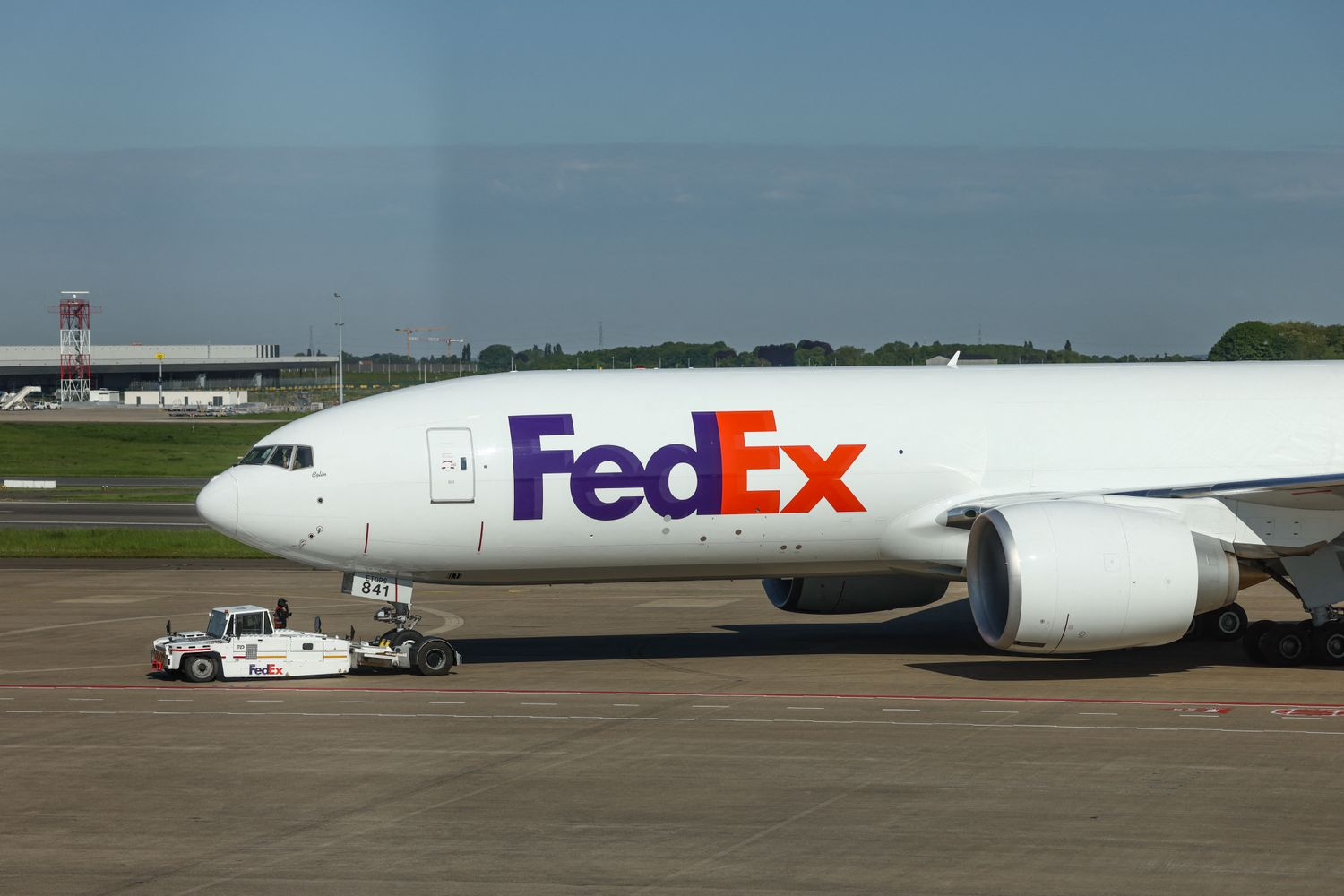
FedEx’s fiscal fourth quarter, announced June 23, 2026, was an adjusted earnings surprise, a double-digit revenue increase and the stock dropped severely even after the hours ended. The gap between reported and market reaction is something to take a closer look at; the numbers are more positive than the headlines make them seem.
The main point that this analysis is trying to answer: Was the sell-off a true decline in the company’s business or a misreading of a transitioning earnings profile with the FedEx Freight spin-off? Remove the accounting mumbo-jumbo and the answer is more towards the latter — and this could be an entry point for investors with a 12 to 18-month time horizon.
Q4 Results: Beat on Earnings, Complexity on the Presentation
FedEx’s revenue for the fiscal fourth quarter that ended on May 31, 2026, amounted to $25.0 billion, up 13% from the previous year’s period when it had revenue of $22.2 billion. Diluted EPS beat the Wall Street consensus by $0.36, or about 6.0%, at $6.31 on an adjusted (non-GAAP) basis. The company has now outperformed the consensus estimate in six of the last seven quarters, and the only negative surprise in the past eight quarters was in the last quarter (Q3 FY2025, –$0.12 or –2.65%).
The GAAP picture is less clear. The Q4 diluted EPS of $6.60 was in line with the previous year’s level of $6.88, representing a 4% decrease year-on-year. Reported operating income dropped to $1.55 billion from $1.79 billion, while reported operating margin decreased to 6.2% from 8.1%. These are all numbers, but they need context – FedEx Freight spin-off costs of $298 million, business optimization costs of $204 million, asset impairment of $23 million and fiscal year-change costs of $13 million. The operating income of those items, adjusted, was $2.09 billion, with an adjusted margin of 8.4%. That is compared to $2.02 billion in adjusted operating income, and 9.1% margin, in the year-ago quarter, representing a slight compression of 70 basis points in the margin line but an absolute dollar gain in operating income.
The 70 basis point adjusted margin fall is worth looking into. Management pointed to higher purchased transportation expenses, higher wages, higher variable incentive compensation, and headwinds due to global trade policy changes. The Federal Express segment, which is the last major segment after the Freight spin-off, reported $21.6 billion in revenue, an increase of 14% from $19.0 billion one year ago.
The operating income in the segments was $1.91 billion with 8.9% margin. The increase was due to increased U.S. domestic and international priority package yields, and ongoing cost savings from the Network 2.0 and DRIVE transformation initiatives.
The FY2026 full-year budget is dedicated to transformation on the cost side of the budget.
FedEx’s total revenue for FY 2026 stood at $94.7 billion, a 8% increase from FY 2025’s $87.9 billion. Adjusted (non-GAAP) diluted EPS for the full year was $20.24, versus $18.19 in FY2025 — an 11.3% increase. The company reported an 8.3% jump in GAAP net income to $4.43 billion from $4.09 billion in FY2025 for the full year.
The most significant annual operating figure is on the cost side, as the company missed the $1 billion mark for cost savings from transformation by a margin. This is important because the DRIVE program is not a one-time cut, it’s a multi-year structural initiative, and the overdelivery on savings in FY2026 indicates that the program has a long runway.
Capital expenditures for FY2026 totaled $3.81 billion, down $246 million (6%) from $4.06 billion in FY2025. That’s the lowest capital intensity that FedEx has reported in its history, according to the earnings release, which was 4.0% of revenue. The free cash flow in the quarterly data has been about $1.0-$1.2 billion per quarter over the last year.
More From Tickzen:
- American Airlines Stock (AAL) Technical Analysis 2026
- Is IREN Stock Overvalued at $61? What the Numbers Say Before You Buy
- EchoStar SATS Stock Analysis 2026: Is the 7x Rally Running Out of Steam?
- Oracle Reports Record Revenue and 93% Cloud Growth. Why the Stock Still Fell
- Accenture Q3 FY2026 Earnings: Stock Beats EPS Estimates But Guidance Cut Sends Shares Lower
The Freight Spin-Off: Accounting Fog, Not Fundamental Deterioration
The biggest reason investors are being confused in these results is due to the treatment of the FedEx Freight spin-off, which was completed June 1, 2026. It’s important to grasp this restructuring so that you can decipher both the results and forward guidance.
The less-than-truckload business (FedEx Freight) has been reclassified for calendar-year comparisons. This indicates that the forward guidance for calendar year 2026 has been provided on a continuing operations basis (excluding Freight). The CY2025 adjusted EPS baseline (ex-Freight) has been re-casted to $15.00 per diluted share. The CY2026 adjusted EPS guidance range of $16.90 to $18.10 implies growth of approximately 12.7% to 20.7% over that $15.00 baseline.
It was a very different picture from the market reaction that was the implication. The decline seems to be a superficial interpretation of the guidance range ($16.90–$18.10) versus the FY2026 full-year adjusted $20.24. But, the two numbers are not necessarily comparable because Freight is included in the first number, but not in the second.
Furthermore, the $13.3 billion cash balance on hand reported in the press release consists of a $4.1 billion cash dividend paid to FedEx Corporation in connection with the spin-off. That dividend is based on the $3.7 billion senior notes offering FedEx Freight that were issued in February 2026 and borrowings under a delayed-draw term loan. The proceeds will be used consistent with maintaining the tax-free nature of the transaction, but not eliminate the near-term capital allocation optionality, management indicated.
Valuation: Not Stretched Given the Growth Trajectory
At the current price of $317.24, the forward P/E is calculated as follows: $317.24 price ÷ $19.50 midpoint of the CY2026 adjusted EPS guidance range ($16.90 to $18.10 gives a midpoint of $17.50; the GAAP midpoint is $17.15, and I’m using the adjusted midpoint per management’s primary guidance metric) = approximately 18.1x on an adjusted basis, or 18.5x on the GAAP midpoint. The report provides a forward P/E of 16.27, which likely reflects a different consensus EPS input; I flag both figures and note that valuation precision depends on which EPS definition is applied.
The provided PEG ratio of 1.39 is derived from the data supplied in the report and is not independently calculated here. At a price-to-sales ratio of 0.82 meaning the market is paying less than $1 for every $1 of annual revenue. The stock does not appear richly valued for a global logistics franchise generating $94.7 billion in annual revenue with a demonstrated cost-cutting track record.
The dividend yield of 1.54% at the current price is modest but growing: management confirmed a 5% increase in the annual dividend on common stock (adjusted for the Freight spin-off), and the company intends to repurchase up to $1 billion in shares during CY2026 under the existing authorization. As of May 31, 2026, $1.3 billion remained under the 2024 repurchase authorization. During FY2026, the company returned approximately $2.2 billion to shareholders via $776 million in buybacks and $1.4 billion in dividends.
Risks That Are Real and Should Be Weighted
Several risks disclosed in the earnings release and observable in the financial data warrant explicit acknowledgment rather than dismissal.
First, trade policy exposure is material and acknowledged. The press release states that Q4 results were “partially offset” by “the financial impacts of global trade policy changes.” FedEx’s forward guidance explicitly assumes “no additional adverse economic, geopolitical, or international trade-related developments.” That is a significant caveat in the current environment.
The company also discloses that approximately $800 million in IEEPA tariff refunds are included in the cash balance pending return to customers meaning that cash is not available for capital allocation. Legal uncertainty around tariff-related accounts receivable is also flagged as a risk factor.
Second, adjusted margin is under mild pressure. The Q4 FY2026 adjusted operating margin of 8.4% contracted from 9.1% a year ago. While this remains above the full-year FY2026 adjusted margin of 7.0%, implying Q4 is seasonally stronger — the year-over-year compression signals that cost savings from DRIVE and Network 2.0 are being partially absorbed by wage inflation and purchased transportation costs rather than flowing entirely to the margin line.
Third, the balance sheet carries significant leverage. Total debt as of February 28, 2026 (the most recent balance sheet period in the data provided) was $42.0 billion, including $16.8 billion in capital lease obligations. Net debt was $17.25 billion. Interest expense net of interest income was $138 million in the most recent quarter. The company’s decision to issue $3.69 billion in long-term debt during the quarter ending February 28, 2026, associated with the Freight spin-off financing increased the absolute debt load, though the cash dividend received from Freight partially offsets the net exposure.
Fourth, the fiscal year transition introduces additional complexity. The company changed its fiscal year end from May 31 to December 31, effective June 1, 2026. This means FY2026 Q4 (ended May 31) is the last quarter under the old fiscal year, and the first CY2026 reporting period will span June through December 2026. Comparisons will be difficult for at least two reporting cycles, and the company has indicated it expects to file recasted historical financials by mid-August 2026. Until those recast figures are publicly available, year-over-year comparisons on a continuing-operations basis will involve estimation.
Earnings Call Themes and Forward Signposts
From the press release and the earnings commentary, the management’s forward strategy is focused on three areas: premium package yield improvement, structural cost reduction and free cash flow growth. CEO Raj Subramaniam explicitly called FedEx “winning in high-value growth markets,” a reference that suggests the company will continue to shift its mix toward International Priority and domestic express volumes, which have higher margins.
The guidance for capital spending for the fiscal year 2026 (FY26) is $3.9 billion, an increase from $3.81 billion in FY25, with a focus on “network optimization and efficiency improvement, such as fleet and facility modernization and automation. The pension contribution is projected to be $475 million for CY2026. The effective tax rate is targeted to be around 23%.
The most significant forward number is revenue growth guidance, which is expected to be around 11% year-over-year (on a continuing-operations basis). FedEx Freight reported $8.8 billion in revenue for FY2026 and $8.9 billion in revenue for FY2025. If Freight is excluded from the full-year total ($94.7B) then the continuing-operations revenue target for CY2026 would be in the range of $95.4B at ~11% growth (assuming a similar calendar-to-fiscal-year split). This is in the right direction, but should be confirmed with the recasted financials due in August 2026.
The data indicate a Buy rating on FedEx at current levels with some caveats.
The thesis, in a nutshell: The stock has sold off after a real earnings beat, as investors misinterpreted the accounting effect of the Freight spin-off on reported EPS vs. continuing operations EPS, and now represents a value entry point into a company with accelerating revenue growth, proven cost discipline and a solid multi-year free cash flow expansion story.
The math behind this perspective: adjusted EPS growth of 11.3% on an as-reported basis; continued operations adjusted EPS guidance implies 12.7%–20.7% growth on top of the CY2025 ex-Freight baseline of $15.00; capital intensity at historical lows; and a forward P/E of 16.27 (per the provided data) on a company that has outperformed consensus in six of its last seven quarters.
The risks that could undermine this perspective are very real: continued contraction of global trade volumes (especially if additional tariff escalation significantly diminishes cross-border express volume); further margin pressure in the Federal Express business; and margin pressure from integration and transition costs associated with the spin-off, which are higher than those presently guided. The trade policy caveat in the guidance language is not boilerplate, it is a true exposure.
The important near-term datapoints that investors should be watching are:
- The recasted historical financials for CY2024 and CY2025, which will be released in August 2026, providing apples-to-apples comparisons of continuing operations.
- The first CY2026 interim earnings report (covering the June–September 2026 period) will be the first true snapshot of continuing operations performance post-spin.
- The outlook for global trade volumes will be a key indicator for International Priority yield sustainability.
The noise has been priced in by the market. The core business, apart from spin-off and restructuring expenses, is expanding, reducing expenses and returning capital. That’s at a sub-17x forward multiple that deserves a second look.