Everspin Technologies (NASDAQ: MRAM) has had one of the more dramatic runs you’ll see in the semiconductor space this year. Between April 27 and May 15, 2026, the stock went from $13.81 to $37.57 — a 172% move in 15 trading sessions. That kind of run makes investors do one of two things: chase it or panic-sell. Neither is a great default reaction.
So let’s slow down and actually look at what the numbers say — because the MRAM stock story in 2026 is more nuanced than the headline return suggests.
What Just Happened: The Catalyst Behind MRAM’s 172% Surge
The move wasn’t random. Everspin Technologies landed a $40 million, 2.5-year subcontract with a leading U.S. defense prime contractor in late April 2026, tied to its Toggle MRAM technology for defense industrial base applications. That announcement landed on April 30, and the stock has barely looked back since.
This came alongside a separately announced strategic manufacturing agreement with Microchip Technology to expand U.S.-based production capacity for MRAM and Tunnel Magnetoresistive (TMR) sensor products — a 10-year deal that significantly expands Everspin’s domestic manufacturing footprint.
Then Q1 2026 results dropped: revenue of $14.87 million versus $13.14 million a year earlier, and a reduced net loss of just $296,000. For a company with 85 employees and a $55.2 million TTM revenue base, that’s a clean quarter by any measure.
Three pieces of good news stacked on top of each other inside 30 days. The stock responded accordingly.
MRAM Stock Analysis 2026: Where Does It Stand Right Now?
At $37.57 (as of May 17, 2026), MRAM is sitting comfortably above its 50-day SMA of $14.90 and its 200-day SMA of $10.78. That’s a bullish moving average alignment, and the MACD confirms short-term upward momentum.
But the RSI is at 73.9 — firmly in overbought territory.
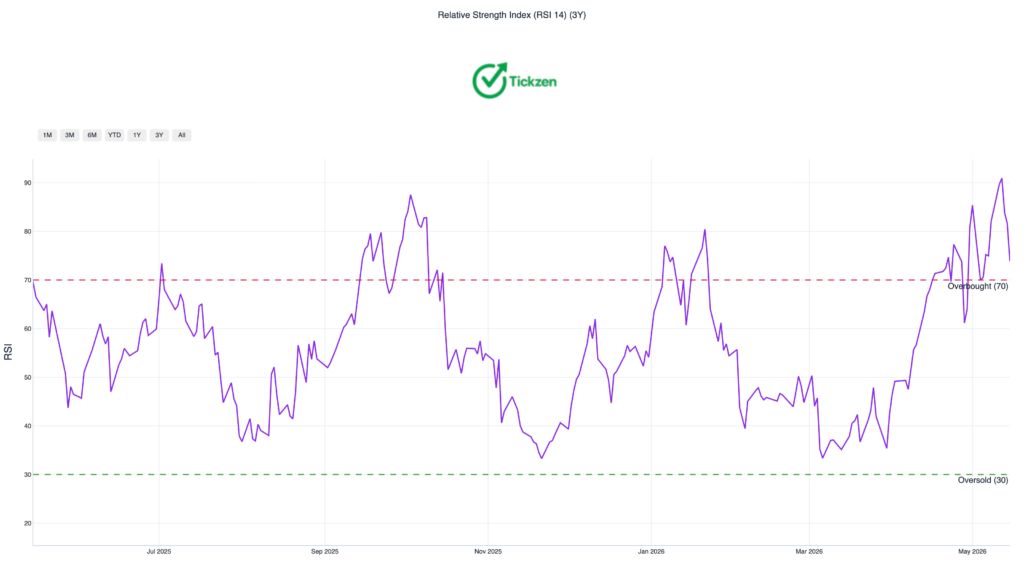
That doesn’t automatically mean sell. Stocks can stay overbought for weeks when momentum is strong. What it does mean is that new buyers at these levels are taking on considerably more risk than someone who got in at $13.81 three weeks ago. The stock has already gained 36.8% above its 20-day SMA — when that gap stretches this wide, mean reversion becomes a real possibility.
Volume is the other issue. The recent rally hasn’t been backed by consistently expanding volume. On May 13, volume hit 15.6 million shares — impressive. But by May 15, it had dropped to 4.4 million. Rising prices on softening volume is rarely a sign of sustained conviction. It can fade.
Key levels to watch:
- $27.46 (20-day SMA): As long as MRAM holds above this, the short-term trend stays intact
- $45.54: A clean breakout above this level with volume would open the next leg higher
- $14.90 (50-day SMA): A meaningful correction target if momentum stalls
The Fundamentals: Everspin Technologies Stock Is Not Cheap
Let’s be direct about this. Everspin Technologies is not a value stock right now.
The trailing P/E sits at 3,757x — a number so extreme it tells you earnings are essentially near zero on a GAAP basis. The forward P/E of 80.8x is more grounded but still prices in aggressive growth that hasn’t arrived yet. Price-to-sales is 15.96x. Price-to-book is 12.53x.
For context: the company earned $0.01 diluted EPS in its latest quarter. Net income for the trailing twelve months was negative $586,000. Operating margin is -7.23%. EBITDA is negative.
That said, gross margin is 51.16% — genuinely solid for a semiconductor business of this size. And quarterly revenue growth of 11.8% YoY shows the top line is moving in the right direction. The company generated $9.96 million in operating cash flow over the trailing twelve months. It has $44.45 million in cash against just $3.34 million in debt. Financially, the balance sheet is in decent shape.
The core issue is the gap between gross profit ($28.24M) and net income (-$586K). Operating expenses are eating up the margin. Until Everspin can translate its 51% gross margins into meaningful operating income, the valuation will remain hard to justify at current prices.
Analyst consensus currently targets $18.00 — which implies about 52% downside from where the stock trades today. That’s a wide gap. Two analysts contributed to that target, and their estimates predate the defense contract news, so there’s a reasonable argument those targets will be revised upward. But even revised targets would likely be well below $37.57.
More From Tickzen:
- Delta Air Lines Stock Analysis 2026: Is DAL Stock a Good Investment Right Now?
- Micron Technology Stock in 2026: Is MU Stock a Good Buy Right Now?
- Is IREN Stock Overvalued at $61? What the Numbers Say Before You Buy
- Delta Air Lines Stock Valuation 2026: DCF Model, Fair Value, and the Hidden Risks Most Investors Miss
- Rocket Lab Stock Analysis 2026: Is RKLB Worth Buying at $105 or Is It Priced for Perfection?
Is MRAM Stock a Good Investment Right Now? The Honest Take
This depends entirely on your time horizon and risk tolerance.
Short-term traders are staring at an RSI of 73.9 and weak volume. Taking partial profits here is defensible. The stock has had a historic run; there’s nothing wrong with locking in some gains while the trend holds and waiting for the next setup.
Long-term MRAM stock investors have a more interesting case to make. The $40M defense contract is real revenue. The Microchip Technology manufacturing deal diversifies the business and strengthens Everspin’s position in the U.S. defense supply chain — a politically durable tailwind given domestic semiconductor policy. Q2 2026 guidance calls for $15.5–16.5 million in revenue, which would be another sequential improvement.
The 52-week range of $5.49 to $51.50 tells you how volatile this stock is. The 30-day historical volatility currently sits at 215.5% — that’s not a typo. If you’re not comfortable with your position dropping 30-40% before recovering, MRAM at $37.57 is probably not the entry point you want.
For new buyers: the technically cleaner entry would be either a pullback to the $27.46 area (20-day SMA), or a confirmed breakout above $45.54 on heavy volume. Chasing a 172% move in 15 days without a clear risk management plan is how people get hurt.
The Bigger Picture: Why MRAM Stock Matters in the Semiconductor Space
Everspin Technologies is the only company shipping MRAM at commercial volume. That’s not marketing — it’s a real competitive moat. Toggle MRAM, STT-MRAM, and TMR sensors serve industrial, medical, automotive, aerospace, and data center markets. The defense contract validates that the technology has cleared the bar for mission-critical applications.
Institutional ownership at 61.56% is healthy — big money isn’t running for the exits. Short interest at 4.09% of float is moderate, not extreme, meaning the short squeeze narrative isn’t the primary driver here.
The Altman Z-Score of 9.54 puts the company firmly in the “safe” zone for bankruptcy risk. That matters when you’re evaluating a small-cap semiconductor company burning operating cash.
MRAM Stock Forecast 2026: What to Watch Next
The next earnings date hasn’t been announced, but Q2 2026 revenue guidance of $15.5–16.5 million will be the first real test of whether the defense momentum translates to the income statement.
Watch for:
- Whether Q2 2026 operating margin improves from the current -7.23%
- Any additional defense or aerospace contract announcements
- Volume behavior on up days — conviction needs to show up there
- Whether institutional ownership continues to expand
The MRAM stock story in 2026 has genuine substance behind it. But at $37.57, you’re paying a significant premium for a narrative that hasn’t fully converted into earnings. That’s not necessarily wrong — plenty of great investments look expensive before the fundamentals catch up. Just know what you’re buying.
This article is for informational purposes only and does not constitute investment advice. Always conduct your own research and consult a qualified financial advisor before making investment decisions.